Obesity is a growing health concern worldwide, and its impact goes far beyond weight alone. Research increasingly shows that excess body fat raises the risk of developing several types of cancer. Understanding this connection can help people make informed choices about their health and take steps to reduce their cancer risk.
To determine someone’s level of body fat, doctors commonly use a measure known as the body mass index (BMI). BMI is calculated by dividing a person’s weight (in kilograms) by their height (in meters) squared (commonly expressed as kg/m2). BMI is not a direct measure of body fat, but it provides a more accurate assessment of obesity than weight alone
The standard weight categories based on BMI for adults ages 20 years or older are:
Below 18.5 is underweight
18.5 – 24.9 Healthy
25 – 29.9 Overweight
30-39.9 Obese
40 or higher severely obese
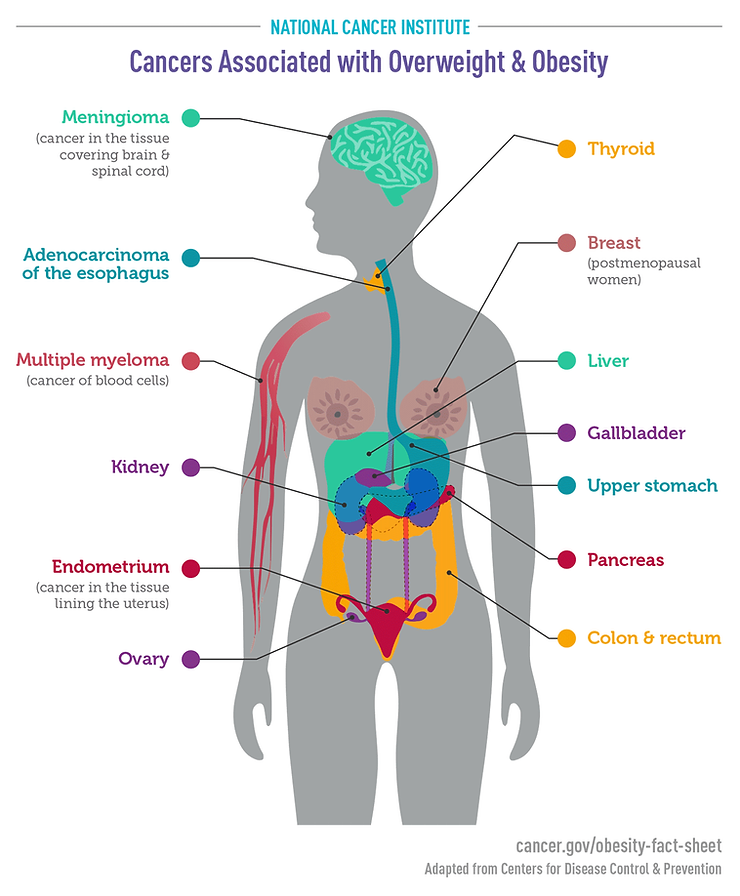
Obesity has become more common in the United States in recent years according to the CDC in the United States 1 in 5 children and 2 in 5 adults have obesity (CDC 2024).Obesity is linked to 13 cancers here’s what you need to know
How Obesity Affects Cancer Risk
Excess body fat influences cancer risk through several biological mechanisms:
Fat cells produce excess estrogen. High levels of estrogen have been associated with increased risks of breast, endometrial, ovarian, and some other cancers Liu et al., 2021).
Obesity is linked to high levels of insulin and insulin like growth factor-1 (IGF -1). High levels of insulin and IGF-1 are associated with increased risks of colorectal, thyroid, breast, prostate, ovarian, and endometrial cancers (Knuppel et al., 2020, Leitner et al., 2020).
Obesity is linked to elevated levels of inflammation which promotes tumor growth (Greten and Grivennikov 2019).
Fat cells produce hormones called adipokines, which can stimulate or inhibit cell growth (Kim et al 2024).
Types of Cancer Linked to Obesity
The best evidence linking overweight and obesity to cancer risk comes from observational studies. According to research studies, cancers that have been found to be linked to obesity or overweight include
endometrial (Setiawan et al., 2013, Dougan et al., 2013)
Obesity is linked to 13 cancer types (National Cancer Institute. Obesity and Cancer Risk)
Why Weight Management Matters
Maintaining a healthy weight can reduce the risk of developing obesity related cancers (Liao et al., 2025). Weight loss improves hormone levels, reduces inflammation, and lowers insulin resistance, all of which help decrease cancer risk. Also, healthy dietary patterns and exercise can decrease cancer risk.
Practical steps to manage weight include:
Eating a balanced diet rich in fruits, vegetables, whole grains, and lean proteins
Engaging in regular physical activity, aiming for at least 150 minutes of moderate exercise per week
Maintain a healthy energy deficit by tracking calories in conjunction with a healthcare provider
Limiting consumption of processed foods, sugary drinks, and red or processed meats
Avoiding smoking and limiting alcohol intake, as these factors also influence cancer risk
The Role of Prevention and Early Detection
While obesity increases cancer risk, it is not the only factor. Genetics, environment, and lifestyle all play roles. Regular health screenings and cancer check-ups are essential, especially for individuals with obesity or other risk factors.
Healthcare providers can offer personalized advice on weight management and cancer screening schedules. Early detection improves treatment outcomes and survival rates.
Taking Action for Your Health
Understanding the link between obesity and cancer risk empowers you to take control of your health. Small, consistent changes in diet and activity can make a significant difference over time. If you are concerned about your weight or cancer risk, consult a healthcare professional for guidance tailored to your needs.
By addressing obesity, you not only improve your overall health but also reduce the chances of developing serious diseases like cancer.
References
Campbell PT, Newton CC, Freedman ND, et al. Body mass index, waist circumference, diabetes, and risk of liver cancer for U.S. adults. Cancer Research 2016; 76(20):6076–6083.
Centers for Disease Control and Prevention. National Center for Chronic Disease Prevention and Health Promotion, Division of Nutrition, Physical Activity, and Obesity: About Obesity | Obesity | CDC (Accessed 01/06/26).
Chen Y, Liu L, Wang X, et al. Body mass index and risk of gastric cancer: A meta-analysis of a population with more than ten million from 24 prospective studies. Cancer Epidemiology, Biomarkers & Prevention 2013; 22(8):1395–1408.
Chen Y, Wang X, Wang J, Yan Z, Luo J. Excess body weight and the risk of primary liver cancer: An updated meta-analysis of prospective studies. European Journal of Cancer 2012; 48(14):2137–2145.
Collaborative Group on Epidemiological Studies of Ovarian Cancer. Ovarian cancer and body size: Individual participant meta-analysis including 25,157 women with ovarian cancer from 47 epidemiological studies. PLoS Medicine 2012; 9(4):e1001200.
Dougan MM, Hankinson SE, Vivo ID, et al. Prospective study of body size throughout the life-course and the incidence of endometrial cancer among premenopausal and postmenopausal women. International Journal of Cancer 2015; 137(3):625–37.
Greten FR, Grivennikov SI. Inflammation and cancer: Triggers, mechanisms, and consequences. Immunity 2019; 51(1):27–41.
Genkinger JM, Spiegelman D, Anderson KE, et al. A pooled analysis of 14 cohort studies of anthropometric factors and pancreatic cancer risk. International Journal of Cancer 2011; 129(7):1708–1717.
Hoyo C, Cook MB, Kamangar F, et al. Body mass index in relation to oesophageal and oesophagogastric junction adenocarcinomas: A pooled analysis from the International BEACON Consortium. International Journal of Epidemiology 2012; 41(6):1706–1718.
Kim JW, Kim JH, Lee YJ. The role of adipokines in tumor progression and its association with obesity. Biomedicines 2024; 12(1):97.
Kitahara CM, Pfeiffer RM, Sosa JA, Shiels MS. Impact of overweight and obesity on US papillary thyroid cancer incidence trends (1995–2015). Journal of the National Cancer Institute 2020; 112(8):810–817.
Knuppel A, Fensom GK, Watts EL, et al. Circulating insulin-like growth factor-I concentrations and risk of 30 cancers: Prospective analyses in UK Biobank. Cancer Research 2020; 80(18):4014–4021.
Leitner BP, Siebel S, Akingbesote ND, Zhang X, Perry RJ. Insulin and cancer: A tangled web. The Biochemical Journal 2022; 479(5):583–607.
Li L, Gan Y, Li W, Wu C, Lu Z. Overweight, obesity and the risk of gallbladder and extrahepatic bile duct cancers: A meta-analysis of observational studies. Obesity (Silver Spring) 2016; 24(8):1786–1802.
Liao CY, Schapiro D, Mojdami D, Sheffield KM, Hoog MM, Keni R, Gathirua-Mwangi WG, Kan H. Intentional Weight Loss and Associated Cancer Incidence Among People With Overweight or Obesity: A Systematic Literature Review. Endocrinol Diabetes Metab. 2025 Sep;8(5):e70104.
Liu XZ, Pedersen L, Halberg N. Cellular mechanisms linking cancers to obesity. Cell Stress 2021; 5(5):55–72.
Ma Y, Yang Y, Wang F, et al. Obesity and risk of colorectal cancer: A systematic review of prospective studies. PLoS One 2013; 8(1):e53916.
Munsell MF, Sprague BL, Berry DA, Chisholm G, Trentham-Dietz A. Body mass index and breast cancer risk according to postmenopausal estrogen-progestin use and hormone receptor status. Epidemiologic Reviews 2014; 36:114–136.
Niedermaier T, Behrens G, Schmid D, et al. Body mass index, physical activity, and risk of adult meningioma and glioma: A meta-analysis. Neurology 2015; 85(15):1342–1350.
Renehan AG, Tyson M, Egger M, Heller RF, Zwahlen M. Body-mass index and incidence of cancer: A systematic review and meta-analysis of prospective observational studies. Lancet 2008; 371(9612):569–578.
Sanfilippo KM, McTigue KM, Fidler CJ, et al. Hypertension and obesity and the risk of kidney cancer in 2 large cohorts of US men and women. Hypertension 2014; 63(5):934–941.
Setiawan VW, Yang HP, Pike MC, et al. Type I and II endometrial cancers: Have they different risk factors? Journal of Clinical Oncology 2013; 31(20):2607–2618.
Watts EL, Gonzalez-Feliciano A, Gunter MJ, Chatterjee N, Moore SC. Adiposity and cancer: systematic review and meta-analysis. medRxiv [Preprint]. 2025 Sep 16:2024.02.16.24302944.
Wang F, Xu Y. Body mass index and risk of renal cell cancer: A dose-response meta-analysis of published cohort studies. International Journal of Cancer 2014; 135(7):1673–1686.
Wallin A, Larsson SC. Body mass index and risk of multiple myeloma: A meta-analysis of prospective studies. European Journal of Cancer 2011; 47(11):1606–1615.
Wentzensen N, Poole EM, Trabert B, et al. Ovarian cancer risk factors by histologic subtype: An analysis from the ovarian cancer cohort consortium. Journal of Clinical Oncology 2016; 34(24):2888–2898.